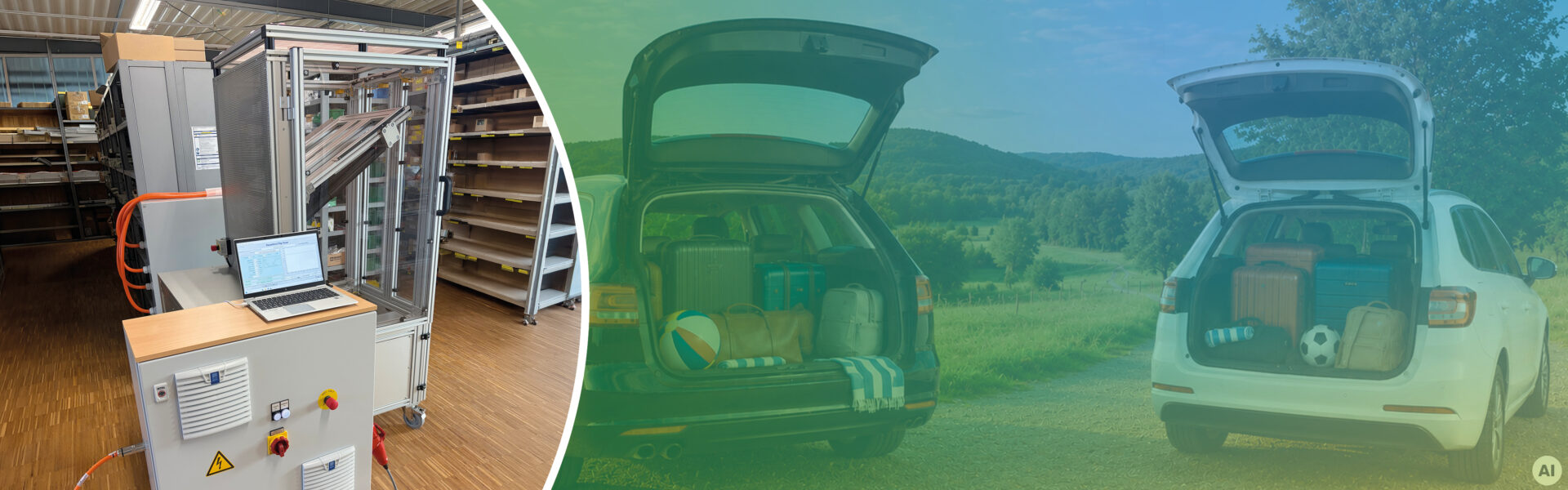
The project was implemented by the SPIE AUTOMATION branch in Haßfurt. Mechanical engineering, software development, electrical design, test bench manufacturing, and control cabinet construction worked hand in hand, supporting the project from the initial concept phase through to commissioning.
The process began with a detailed review of the functional specification to capture all mechanical, electrical, and software requirements. A key focus was placed on required operating conditions, interfaces, and limit values essential for reliable, continuous operation.
Based on these specifications, the mechanical design of the test bench was created. The concept was coordinated with the customer and released for production. In parallel, all electrical components were selected, using exclusively high-grade parts that satisfy stringent demands for precision, reliability, and operational safety.
The complete system concept—encompassing mechanical systems, electrical engineering, and software architecture—was then presented to the customer and finalized collaboratively. Following sign-off, manufacturing of the test bench began. Concurrently, electrical schematics were drawn up, the control cabinet was built, and the software was adapted to the new hardware.
Once mechanical and electrical assembly were complete, electrical installation and initial hardware commissioning took place. In the next step, the PC application was integrated, and the entire system was fully commissioned. All functions were rigorously tested, validated, and verified for continuous operation reliability.
At project completion, SPIE AUTOMATION supplied comprehensive technical documentation, including circuit diagrams, bills of materials, software specifications, operating manuals, and safety assessments. Furthermore, the test rig was engineered in compliance with all applicable CE standards and directives before handover to the customer.